
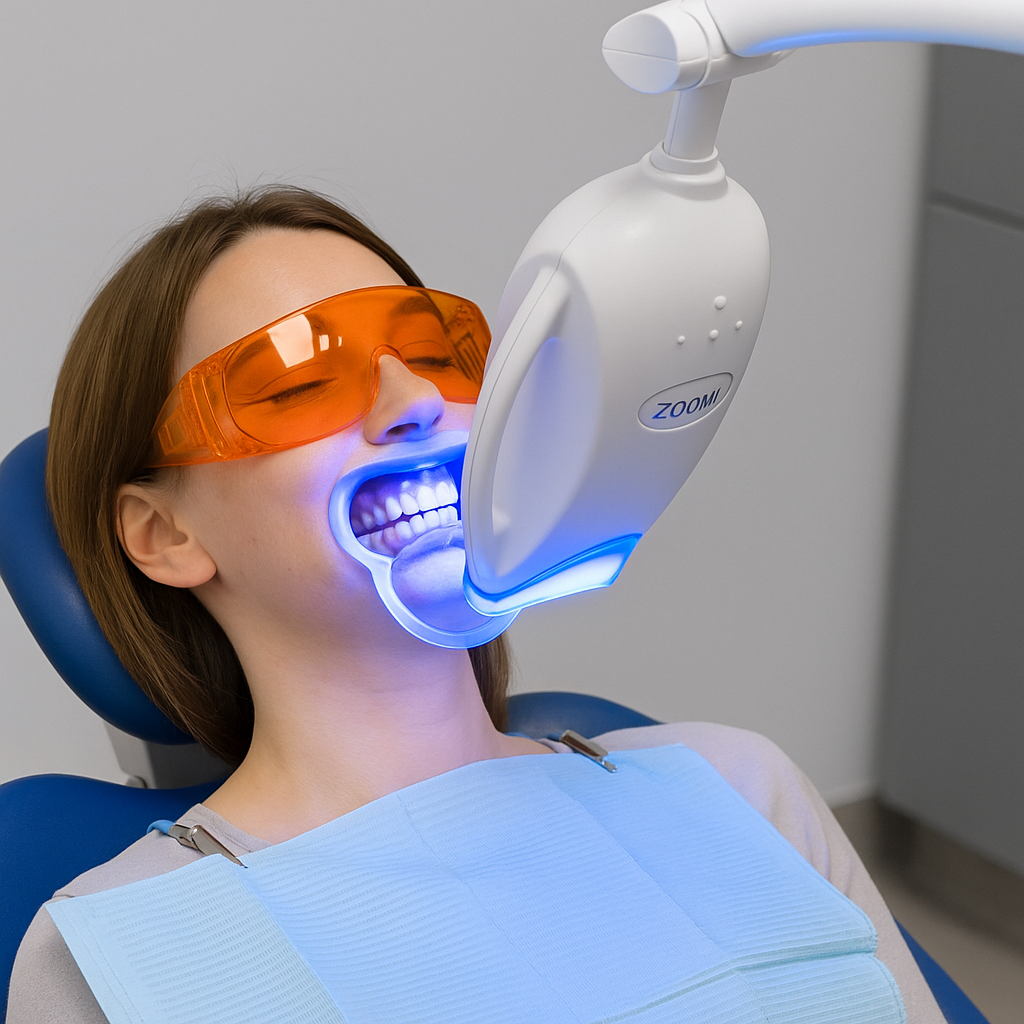
Professional Teeth Whitening in Kitchener
Philips Zoom! WhiteSpeed Whitening at MI Dental
Professional teeth whitening can brighten natural teeth affected by aging, food, drinks, tobacco and other causes of discolouration.
At MI Dental in Kitchener, we offer Philips Zoom! WhiteSpeed, an in-office whitening system designed for patients who want a noticeable colour improvement without wearing whitening trays for several days or weeks.
The active whitening portion of a WhiteSpeed appointment is generally completed in approximately 45 minutes. Additional time is required to assess your teeth, record the starting shade, protect the lips and gums and provide post-treatment instructions.
Philips reports that WhiteSpeed can produce a change of up to eight shade-guide steps in one visit. That is a potential result rather than a guarantee. Starting shade, type of discolouration, tooth anatomy, age and previous dental treatment all influence the outcome.
Our goal is not to make every patient’s teeth unnaturally white. It is to determine whether whitening is appropriate and achieve a brighter result that remains believable within your smile.
A Quick Overview
| Question | Answer |
|---|---|
| What system do we use? | Philips Zoom! WhiteSpeed |
| What does it whiten? | Natural tooth enamel and dentin |
| How long does treatment take? | Approximately 45 minutes of active whitening, plus preparation and assessment |
| How much whiter will teeth become? | Results vary; Philips reports up to eight shade-guide steps |
| Will crowns and fillings whiten? | No |
| Can sensitivity occur? | Yes, although it is commonly temporary |
| Is an examination needed first? | Yes, to assess whether your teeth and gums are suitable |
Why Do Teeth Become Darker?
Tooth discolouration is not one single condition. Understanding its cause helps us predict whether whitening is likely to work.
Extrinsic Surface Staining
Extrinsic stains accumulate on the outside of the enamel.
Common contributors include:
- Coffee
- Tea
- Red wine
- Cola
- Darkly pigmented foods
- Smoking or tobacco
- Plaque and tartar
- Certain mouth rinses
Some surface stain may be removed during a professional cleaning. Whitening may then be used when the underlying natural tooth colour also needs to be lightened.
Intrinsic Discolouration
Intrinsic colour lies within the enamel or dentin.
It may be influenced by:
- Natural aging
- Tooth development
- Fluorosis
- Tetracycline or other medication-related staining
- Previous trauma
- Changes within the pulp
- The natural thickness and translucency of enamel
- Genetic differences in tooth colour
Intrinsic stains may respond to whitening, but the result is less predictable.
Yellow and brown shades commonly respond better than grey colouring or pronounced bands. Teeth affected by fluorosis or tetracycline may lighten unevenly or require a longer treatment plan. They should not automatically be described as impossible to whiten.
A Single Dark Tooth
When one tooth is significantly darker than the others, generalized whitening may not be the first or only treatment required.
A single dark tooth could be associated with:
- Previous trauma
- Loss of vitality
- Root canal treatment
- A large filling
- Internal bleeding or pulpal changes
- Developmental differences
The tooth should be evaluated before cosmetic treatment. Depending on the cause, options could include external whitening, internal whitening of a root-canal-treated tooth, dental bonding, a veneer or a crown.
How Does Teeth Whitening Work?
Professional whitening uses peroxide to change the colour of compounds within enamel and dentin.
Hydrogen peroxide diffuses through the tooth’s hard tissues and forms reactive oxygen molecules. These interact with coloured organic compounds and break them into smaller, less visibly pigmented molecules.
Whitening therefore changes tooth colour chemically. It does not work by sanding away a layer of enamel.
Whitening toothpaste is different. It usually relies primarily on mild abrasives to remove external surface stains and generally has less effect on the internal colour of the tooth.
What Is Philips Zoom! WhiteSpeed?
Philips Zoom! WhiteSpeed is a professionally administered in-office whitening system.
The current system combines:
- Hydrogen-peroxide whitening gel
- Isolation of the gums and soft tissues
- A proprietary blue LED lamp
- Three or four timed applications, depending on the protocol and patient response
- Professional supervision
- Post-treatment sensitivity-management products where appropriate
The WhiteSpeed instructions describe a typical treatment as three to four 15-minute gel applications.
What Does the Zoom Light Do?
The WhiteSpeed lamp is used as part of Philips’ prescribed treatment protocol.
It is important to understand that the peroxide gel is the active bleaching agent. The light does not independently whiten teeth and does not scrub or burn away staining.
Research comparing light-activated and non-light-activated in-office systems has produced mixed results. Recent evidence suggests that light activation does not consistently add whitening benefit and may influence sensitivity in some protocols.
We therefore do not choose Zoom simply because it has a bright lamp. We use it as a complete professional system that provides:
- Controlled peroxide delivery
- Careful isolation
- Timed treatment cycles
- Adjustable treatment parameters
- A standardized clinical protocol
- Professional assessment and monitoring
What Happens During Zoom Teeth Whitening?
1. Examination and Candidacy Assessment
Before whitening, we assess your teeth and gums.
We look for:
- Untreated cavities
- Cracks
- Leaking or failing fillings
- Gum inflammation
- Significant recession
- Areas of exposed root surface
- Existing crowns, veneers or bonding
- Previous sensitivity
- The type and distribution of discolouration
- Signs that a dark tooth may have another underlying cause
Philips recommends screening patients before WhiteSpeed treatment and addressing active oral disease or failing restorations first.
2. Discussing Expectations
We explain what is likely to whiten and what will remain unchanged.
Teeth do not all respond identically. The final result depends on:
- Starting colour
- Yellow, brown or grey undertones
- Enamel thickness
- Age
- Previous trauma
- Fluorosis or medication-related staining
- Existing dental work
- Natural variations among individual teeth
Whitening should make the teeth brighter, but it cannot guarantee a specific final shade.
3. Recording the Starting Shade
The initial tooth shade is recorded using a dental shade guide and may also be photographed.
This gives us a reference for comparing the result after treatment.
4. Protecting the Lips and Gums
A retractor is positioned to keep the lips and cheeks away from the teeth.
Protective materials are placed over the gums and other soft tissues to reduce contact with the whitening gel. Protective eyewear is also used.
Careful isolation is one of the major differences between supervised in-office treatment and unsupervised application of stronger products.
5. Applying the Whitening Gel
A controlled layer of WhiteSpeed gel is placed on the visible surfaces of the teeth being treated.
The Zoom lamp is positioned, and the treatment proceeds through timed cycles. The gel is removed and refreshed according to the system’s protocol.
The complete treatment commonly consists of three or four 15-minute applications. The number of cycles may be adjusted according to sensitivity, treatment tolerance and clinical judgment.
6. Monitoring Comfort
Some patients feel little during treatment. Others experience brief sensations often described as a “zing” or sudden sensitivity.
Tell us immediately if you experience:
- Significant tooth sensitivity
- Burning
- Gum discomfort
- Heat
- Pain in a particular tooth
The treatment can be paused or modified when necessary.
7. Final Shade Assessment
After the whitening gel and protective barrier are removed, we compare the new shade with the starting record.
The immediate result can be striking. However, colour may settle slightly after the teeth rehydrate, so the same-day appearance should not be treated as a guaranteed permanent shade.
8. Post-Treatment Instructions
You receive instructions regarding:
- Sensitivity management
- Food and drink
- Oral hygiene
- Maintenance
- Existing restorations
- When to contact us
Is Professional Whitening Better Than Drugstore Whitening?
Professional treatment is not the only legitimate method of whitening.
There are three broad options.
| Option | Advantages | Limitations |
|---|---|---|
| In-office whitening | Fast result, professional isolation, supervised treatment | Higher cost, temporary sensitivity may occur |
| Dentist-supervised take-home trays | Gradual and controllable; custom tray fit | Requires consistent use over several days or weeks |
| Over-the-counter strips or gels | Accessible and less expensive | Slower, less individualized and may not fit every tooth evenly |
| Whitening toothpaste | Helps remove surface stain | Limited effect on internal tooth colour |
| DIY acids and abrasive powders | None that justify the risk | May be ineffective, erosive or excessively abrasive |
Some reputable OTC products can produce whitening when used correctly. The problem is not that every drugstore product is dangerous; it is that patients may use an unsuitable product, overuse it, apply it over untreated disease or expect it to correct a problem that is not actually a whitening problem.
The ADA recognizes peroxide-based OTC strips, dentist-supervised trays and in-office treatment as established whitening approaches.
Whitening Myths and Internet Hacks
Charcoal Powder
There is insufficient evidence that charcoal products provide reliable whitening with adequate safety. Some charcoal-containing mixtures have been shown to be abrasive and ineffective.
Lemon Juice and Vinegar
Acidic products do not safely bleach teeth. Repeated acid exposure can soften and erode enamel, eventually making teeth more sensitive and potentially more yellow as the underlying dentin becomes visible.
Baking Soda
Baking soda should not be treated as automatically dangerous in every form; it is used in some properly formulated toothpastes.
However, homemade mixtures have not demonstrated predictable bleaching, and aggressive scrubbing or combining baking soda with acids is not an appropriate whitening treatment.
Household Hydrogen Peroxide
Do not place household peroxide directly on the teeth or gums. Concentration, formulation, exposure time and tissue isolation matter.
Oil Pulling
Oil pulling has not been shown to bleach the internal colour of teeth. It should not replace brushing, interdental cleaning or professional evaluation.
Who Is a Good Candidate for Zoom Whitening?
WhiteSpeed may be appropriate for adults who:
- Have healthy teeth and gums
- Want to lighten natural teeth
- Have generalized yellow or brown discolouration
- Prefer a result in one appointment
- Understand that results vary
- Do not have extensive unmatched restorations in the visible smile
- Are willing to accept the possibility of temporary sensitivity
The manufacturer’s current instructions indicate that WhiteSpeed is intended for healthy patients aged 18 and older.
When Might Whitening Need to Be Delayed or Reconsidered?
Whitening may need to be postponed or another option considered when there is:
- Untreated tooth decay
- Active gum disease
- Failing or leaking restorations
- Severe current sensitivity
- Cracked teeth
- Significant exposed roots
- Unexplained pain
- One dark tooth that requires diagnosis
- Extensive front-tooth crowns, veneers or bonding
- Unrealistic expectations
- Pregnancy or breastfeeding
- Age under 18 for the WhiteSpeed system
Philips lists pregnancy, lactation and age under 18 among its WhiteSpeed contraindications.
This does not necessarily mean a patient can never improve the appearance of their teeth. It means the underlying issue should be addressed or a different treatment plan discussed.
What Will Not Whiten?
Whitening gel changes the colour of natural tooth structure.
It does not change the shade of:
- Composite fillings
- Dental bonding
- Porcelain veneers
- Ceramic crowns
- Zirconia crowns
- PFM crowns
- Implant crowns
- Denture teeth
This can create a mismatch if natural teeth brighten while visible restorations remain the previous shade.
Planning Whitening with Veneers, Crowns or Bonding
When whitening and new cosmetic restorations are both being considered, whitening is commonly completed first.
After the tooth shade stabilizes, new bonding, porcelain veneers or dental crowns can be matched to the brighter colour.
The WhiteSpeed instructions advise waiting before placing bonded restorations following whitening.
Will Whitening Cause Sensitivity?
Temporary sensitivity is the most common side effect of tooth whitening.
Peroxide can travel through enamel and dentin toward the pulp. This can temporarily increase the tooth’s response to cold, air or pressure.
Sensitivity may feel like:
- Brief sharp sensations
- General cold sensitivity
- Intermittent “zingers”
- Mild aching
The risk may be influenced by:
- Existing sensitivity
- Recession
- Cracks
- Exposed dentin
- Peroxide concentration
- Treatment duration
- Previous restorations
- Individual tooth anatomy
Sensitivity is commonly temporary, but no whitening procedure should be advertised as sensitivity-free.
How We Manage Sensitivity
Depending on your history, we may recommend:
- Desensitizing toothpaste before treatment
- Modification of the treatment cycles
- Stopping treatment early if necessary
- Post-treatment desensitizing products
- Philips Relief ACP gel where appropriate
- Additional evaluation if one tooth reacts differently from the others
Philips includes Relief ACP within certain WhiteSpeed kits and describes it as a product used for whitening-related sensitivity.
How White Will My Teeth Become?
The result cannot be predicted from a photograph alone.
Philips reports changes of up to six to eight shade-guide steps for many patients, but the actual change depends on:
- Starting shade
- Stain type
- Age
- Tooth condition
- Enamel thickness
- Calcification
- Previous treatment
- Individual response
Yellow and brown shades commonly show a more noticeable response. Grey bands, pronounced fluorosis and tetracycline-related discolouration may improve less evenly or require additional treatment.
Whitening also does not create an opaque “paper white” colour. Natural teeth retain variations in translucency and shade.
How Long Do Whitening Results Last?
Whitening is not permanent.
The colour may gradually darken again because of:
- Coffee and tea
- Red wine
- Tobacco
- Pigmented foods
- Natural aging
- Oral-hygiene habits
- Individual enamel and dentin characteristics
Some patients maintain their result for a considerable period, while others prefer occasional touch-ups.
There is no responsible way to promise that every patient’s whitening will last a specific number of months or years.
After Your Whitening Appointment
For the First Few Hours
Philips advises avoiding coffee, tea, red wine and tobacco for approximately two hours after treatment while the salivary pellicle reforms.
Water is the safest drink during this initial period.
If Sensitivity Occurs
Sensitivity is usually temporary.
Use the recommended sensitivity product and avoid very cold foods and drinks until the teeth feel comfortable.
Contact us if:
- Pain is severe
- Sensitivity continues unexpectedly
- One tooth is substantially more painful than the others
- Gum irritation does not settle
Continue Normal Oral Hygiene
Brush gently with fluoride toothpaste and continue cleaning between the teeth.
Do not scrub aggressively in an attempt to maintain the result.
Alternatives to Generalized Teeth Whitening
Whitening is excellent for changing generalized natural tooth colour, but it cannot correct every cosmetic concern.
Other options may include:
Professional Cleaning
Surface stain and tartar may sometimes be improved with scaling and polishing before bleaching is considered.
Internal Whitening
A dark root-canal-treated tooth may be treated internally in selected cases.
Dental Bonding
Dental bonding may conceal localized discolouration or repair a chipped area.
Porcelain Veneers
Porcelain veneers may be considered when colour concerns occur together with significant changes in shape, wear or spacing.
Dental Crowns
A dental crown may be appropriate when the tooth is heavily restored or structurally weakened and requires more than a cosmetic colour change.
Enamel Microabrasion or Other Conservative Treatments
Selected superficial enamel irregularities may respond to treatments other than bleaching.
The correct option depends on the cause and depth of the discolouration.
Why Choose MI Dental for Teeth Whitening in Kitchener?
We Diagnose Before We Whiten
Not every dark tooth is a simple stain. We assess cavities, cracks, gum health, restorations and the pattern of discolouration before treatment.
Professional Soft-Tissue Protection
The lips, cheeks and gums are isolated before stronger whitening gel is placed.
Realistic Expectations
We explain what will whiten, what will not and how the starting shade affects the likely result.
Sensitivity Is Taken Seriously
We do not dismiss sensitivity or promise that it cannot occur. Treatment is monitored and modified according to your response.
Cosmetic Treatment Is Planned in the Correct Order
When bonding, veneers or crowns are also being considered, we plan whitening first where appropriate so the restorations can be matched afterward.
Natural-Looking Results
The objective is a brighter version of your natural smile, not an artificial colour that does not suit the surrounding teeth.
Frequently Asked Questions
How long does Zoom whitening take?
The active WhiteSpeed treatment generally takes approximately 45 minutes. Your full appointment is longer because time is required for assessment, shade recording, soft-tissue protection, preparation and post-treatment instructions.
Can Zoom whiten my teeth by eight shades?
Philips reports results of up to eight shade-guide steps in one visit. This is not guaranteed for every patient.
The type of stain, starting colour, age and tooth structure influence the result.
Does Zoom whitening damage enamel?
When used according to the professional protocol on appropriately selected patients, Philips describes WhiteSpeed as safe for enamel.
However, we avoid absolute phrases such as “zero enamel damage.” Whitening is a biologically active procedure that can cause temporary sensitivity and must be used appropriately.
Is Zoom whitening painful?
Many patients complete treatment comfortably, but temporary sensitivity or intermittent sharp sensations can occur.
The treatment can be adjusted or stopped if discomfort becomes significant.
Will my crowns or fillings whiten?
No. Whitening affects natural tooth structure, not restorative materials.
Visible restorations may need to be replaced afterward if they no longer match.
Can I whiten my teeth if I have sensitive teeth?
Possibly.
The cause and severity of the sensitivity should be assessed first. Pretreatment desensitizing products or a modified whitening plan may be recommended.
Does whitening work on tetracycline stains?
It may improve them, but the result is generally slower and less predictable than whitening yellow or brown age-related discolouration.
Extended dentist-supervised treatment or restorative options may need to be considered.
Can I have whitening while pregnant or breastfeeding?
Philips lists pregnancy and lactation as contraindications for WhiteSpeed treatment, so treatment should be postponed.
How long should I wait before getting bonding or veneers?
The treatment should be sequenced carefully because whitening temporarily affects tooth shade and may affect bonding conditions.
We generally allow the colour to stabilize before selecting the final shade and placing new cosmetic restorations.
Is professional whitening permanent?
No.
Results gradually change with aging, diet and habits. Periodic maintenance may be considered when appropriate.
Brighten Your Natural Smile
Professional teeth whitening can provide a noticeable improvement without changing the shape or structure of otherwise healthy teeth.
The first step is determining whether whitening is appropriate for your type of discolouration, existing restorations and dental health.
Contact MI Dental to schedule a Philips Zoom! WhiteSpeed consultation or professional teeth-whitening appointment in Kitchener.
